April 17, 2026 · 12 min read
The 10 Best Canny Alternatives in 2026 (Free + Paid)
An honest comparison of the top Canny alternatives — feature parity, pricing, integrations, and what each tool is actually best for. Updated for 2026.
Canny kicked off the modern feedback-tool category and is still a solid product. But in 2026 it faces stiff competition from tools that are cheaper, faster to set up, or bundle additional features like changelogs, help centers and AI prioritization. If you're evaluating alternatives, the question isn't "what replaces Canny?" — it's "which of these alternatives matches your team's workflow and budget?"
We tested and reviewed ten popular Canny alternatives — from feature-parity tools at a fraction of the price, to broader platforms that include support and help-desk features, to open-source options you can self-host. Below you'll find a quick-pick guide, a full feature comparison table, and honest breakdowns of each tool. We built Feentra, so we're biased — but we've tried to keep this fair and flag where each competitor beats us.
Quick picks
Best for simple feedback at flat pricing
Feentra
Best all-in-one (support + feedback)
Featurebase
Best for enterprise PM teams
Productboard
Best open-source / self-hosted
Fider
Best on a tight budget
Sleekplan
Best-looking feedback board
Nolt
At a glance
Features, pricing, and key gaps across all ten tools.
| Tool | Starting price | Free plan | Voting | Roadmap | Changelog | AI priority | AI duplicates | Integrations | Embed widget | Custom domain |
|---|---|---|---|---|---|---|---|---|---|---|
| Feentra | Free · $29/mo Pro | |||||||||
| Featurebase | Free · $29/seat/mo | |||||||||
| Frill | $25/mo | |||||||||
| Nolt | $29/mo | |||||||||
| Sleekplan | Free · $13/mo | |||||||||
| Productboard | $15/maker/mo | |||||||||
| Upvoty | $25/mo | |||||||||
| Fider | Free (self-hosted) | |||||||||
| Gleap | $39/mo | |||||||||
| UserVoice | $699/mo |
The 10 best Canny alternatives, reviewed
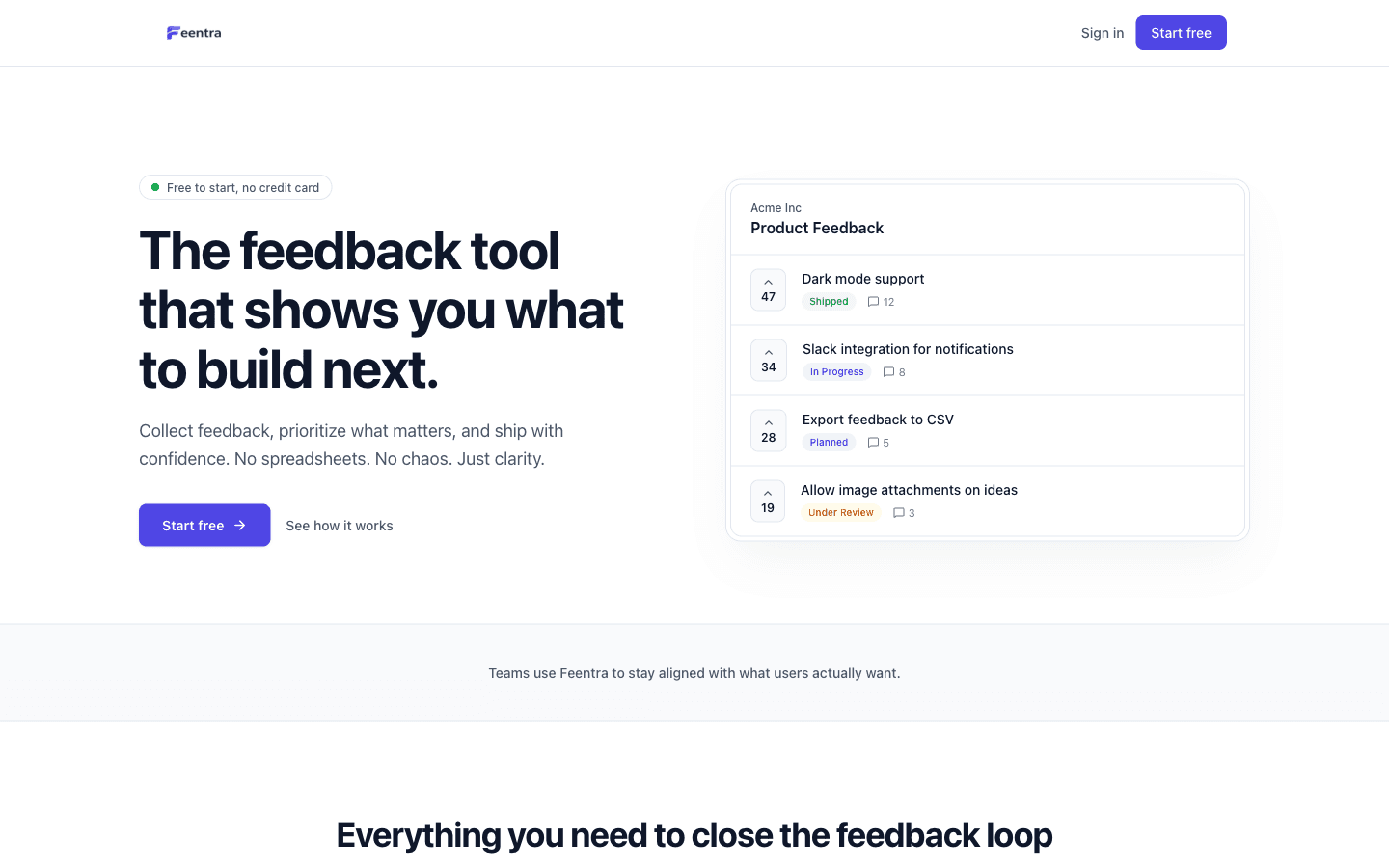
Simple feedback boards, AI prioritization, and a public roadmap at flat pricing.
Best for
Teams that want Canny's core workflow without per-seat pricing or enterprise overhead.
Pros
- Free plan includes unlimited ideas and votes on one board
- Flat pricing — no per-seat fees, your whole team shares one plan
- AI priority scoring + AI duplicate detection on all plans
- Public voting boards with no login required
- GitHub, Jira, Asana, Slack and Teams integrations on Pro
- Live in under a minute — no setup maze
Cons
- Newer to market — fewer public case studies than established competitors
- No native support inbox or help center (by design — stays focused)
- No changelog product yet (on the roadmap)
Pricing: Free forever plan. Pro $29/mo flat. Team $79/mo flat.
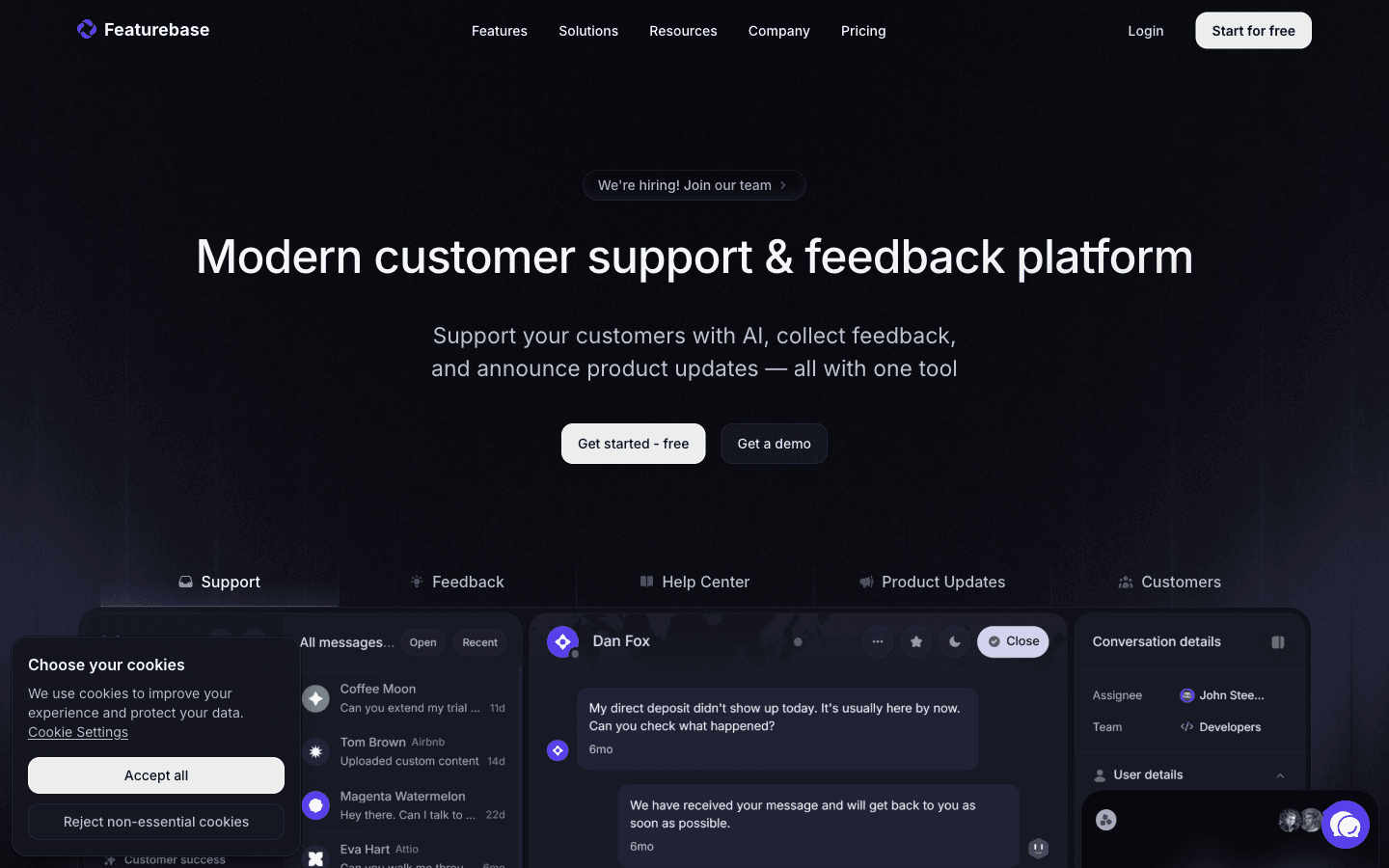
A feedback platform bundled with a full support inbox, help center, and AI support agent.
Best for
Teams that want to replace Intercom + Canny + a changelog tool with one product.
Pros
- Unified product — support, feedback, changelog, and help center in one tool
- AI support agent (Fibi) that auto-resolves tickets
- Strong customer list including OpenSea, Lovable and User.com
- SOC 2 certified
- Multilingual Help Center support
Cons
- Per-seat pricing adds up fast (5 seats = $145/mo minimum on Growth)
- Feature surface is broad — can feel overwhelming if you just want feedback
- AI resolutions billed separately ($0.29 each)
Pricing: Free plan (1 seat). Growth $29/seat/mo. Professional $59/seat/mo. Enterprise $99/seat/mo (billed annually).
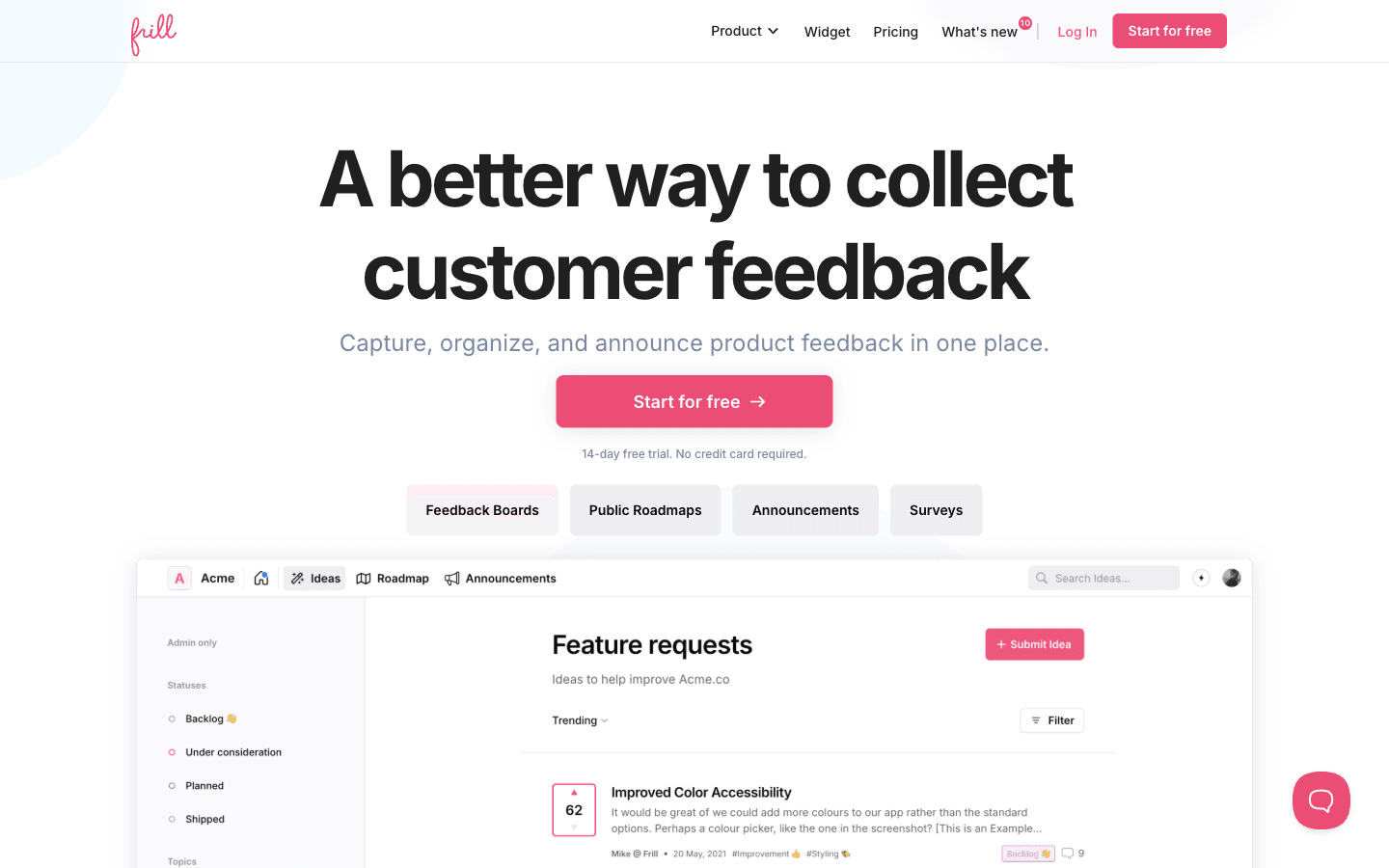
Feature requests, roadmaps, and announcements in a friendly, approachable package.
Best for
Small SaaS teams that want a clean feedback board with a simple announcement widget.
Pros
- Clean, approachable UI — easy to set up
- Built-in announcement widget to share updates
- 14-day free trial with no credit card
Cons
- No free plan — trial only
- No Jira or Asana integration
- Unlimited ideas require Business ($49/mo) or higher
- No AI features
Pricing: Startup $25/mo. Business $49/mo. Growth $149/mo. Enterprise from $349/mo. 14-day trial, no free plan.
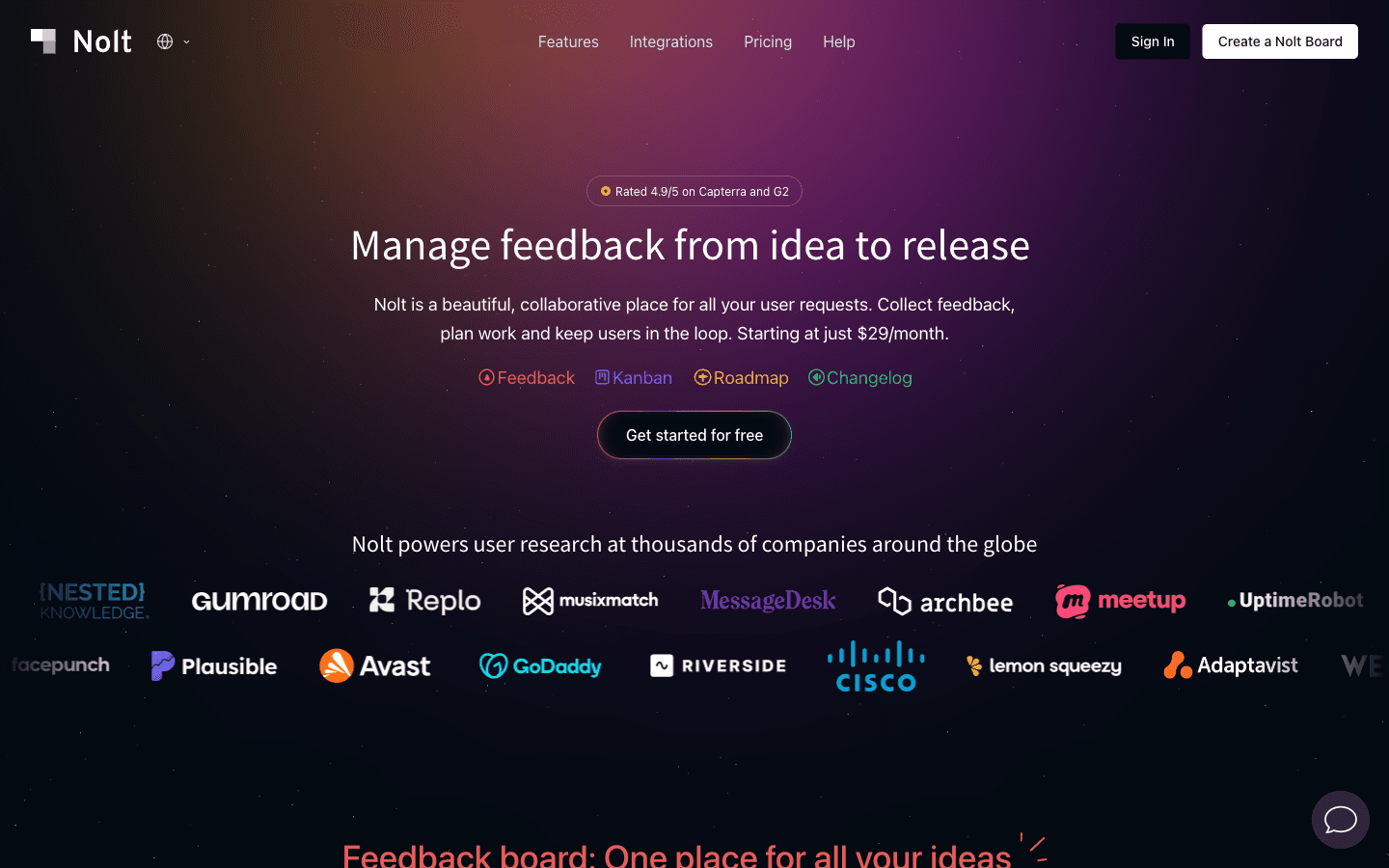
A beautifully designed feedback board focused on simplicity and clarity.
Best for
Small teams and indie devs who want a gorgeous, minimalist feedback board.
Pros
- Stunning UI — arguably the best-looking feedback tool on the market
- Customizable themes and branding
- Rated 4.9/5 on Capterra and G2
- Used by Avast, Plausible, GoDaddy and others
Cons
- No free plan — $29/mo minimum
- No GitHub, Jira or Asana integrations
- No AI features
- No embeddable widget
Pricing: Starts at $29/mo. No free plan.
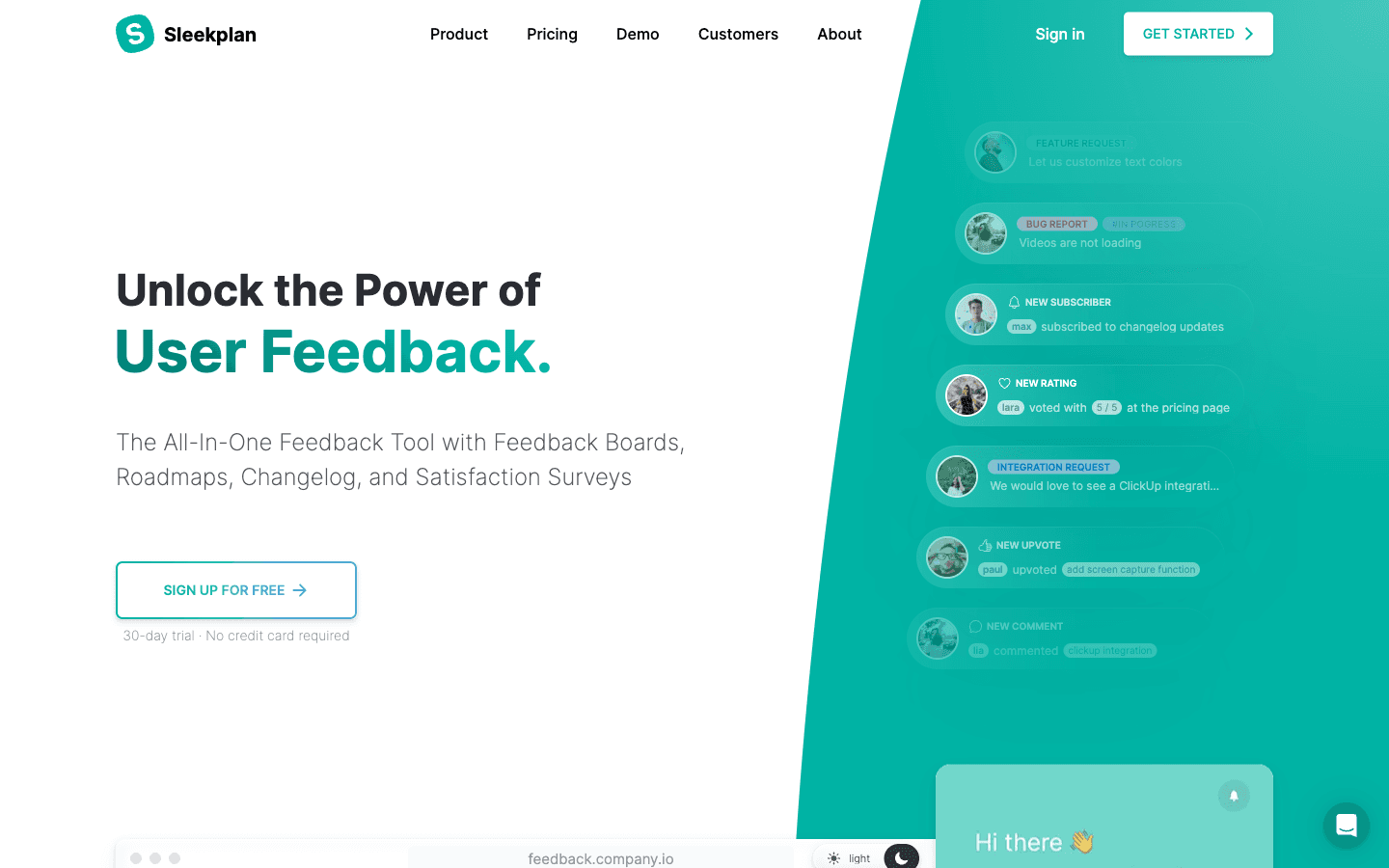
An all-in-one user feedback tool with boards, roadmaps, changelog, and satisfaction surveys.
Best for
Teams that want feedback plus NPS/CSAT surveys and a changelog without paying enterprise prices.
Pros
- Very affordable paid tier ($13/mo)
- Includes surveys (CSAT/NPS), changelog, and roadmap out of the box
- Advanced prioritization scoring on paid plans
- 30-day Business trial with no credit card
Cons
- Free tier limited to feedback board + changelog only
- UI feels dense compared to minimalist competitors
- Annual billing required for lowest prices
Pricing: Free Indie plan (1 seat). Starter $13/mo (annual). Business $38/mo (annual).
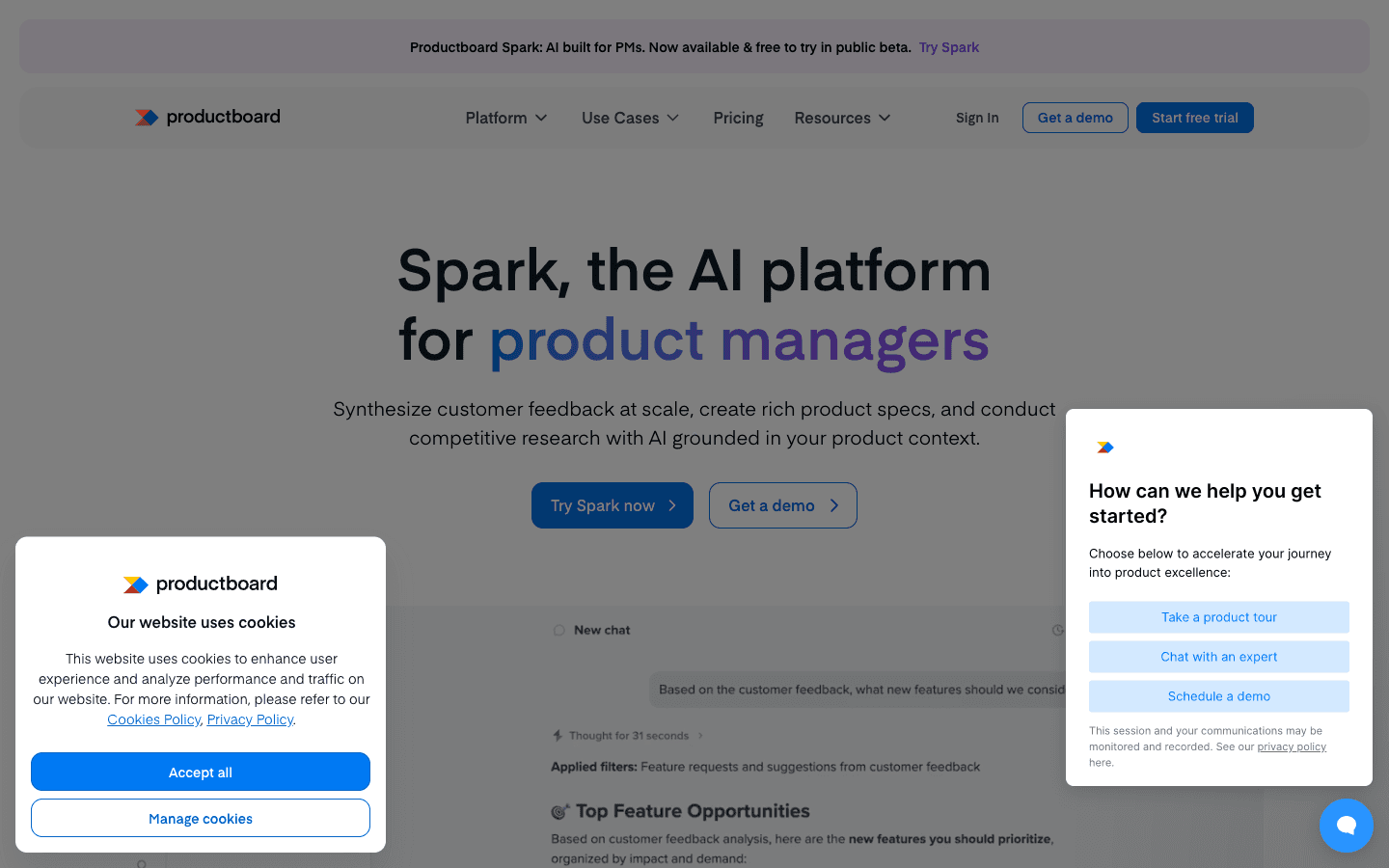
A full product management suite with customer feedback, roadmapping, and AI synthesis.
Best for
PM-heavy orgs that want to synthesize feedback at scale across multiple customer channels.
Pros
- Powerful AI (Spark) for synthesizing feedback and generating product specs
- Deep integrations with Jira, Salesforce, Zendesk
- Used by enterprise product teams
- Advanced prioritization frameworks (RICE, custom scoring)
Cons
- Per-maker pricing — a 5-person team pays $75–95/mo minimum
- Steep learning curve and long setup
- Overkill if you just want a public voting board
- Public feedback boards gated to higher plans
Pricing: Spark $15/maker/mo (annual) or $19/maker/mo (monthly). Higher-tier plans available for larger orgs. No free plan (150 one-time trial credits).
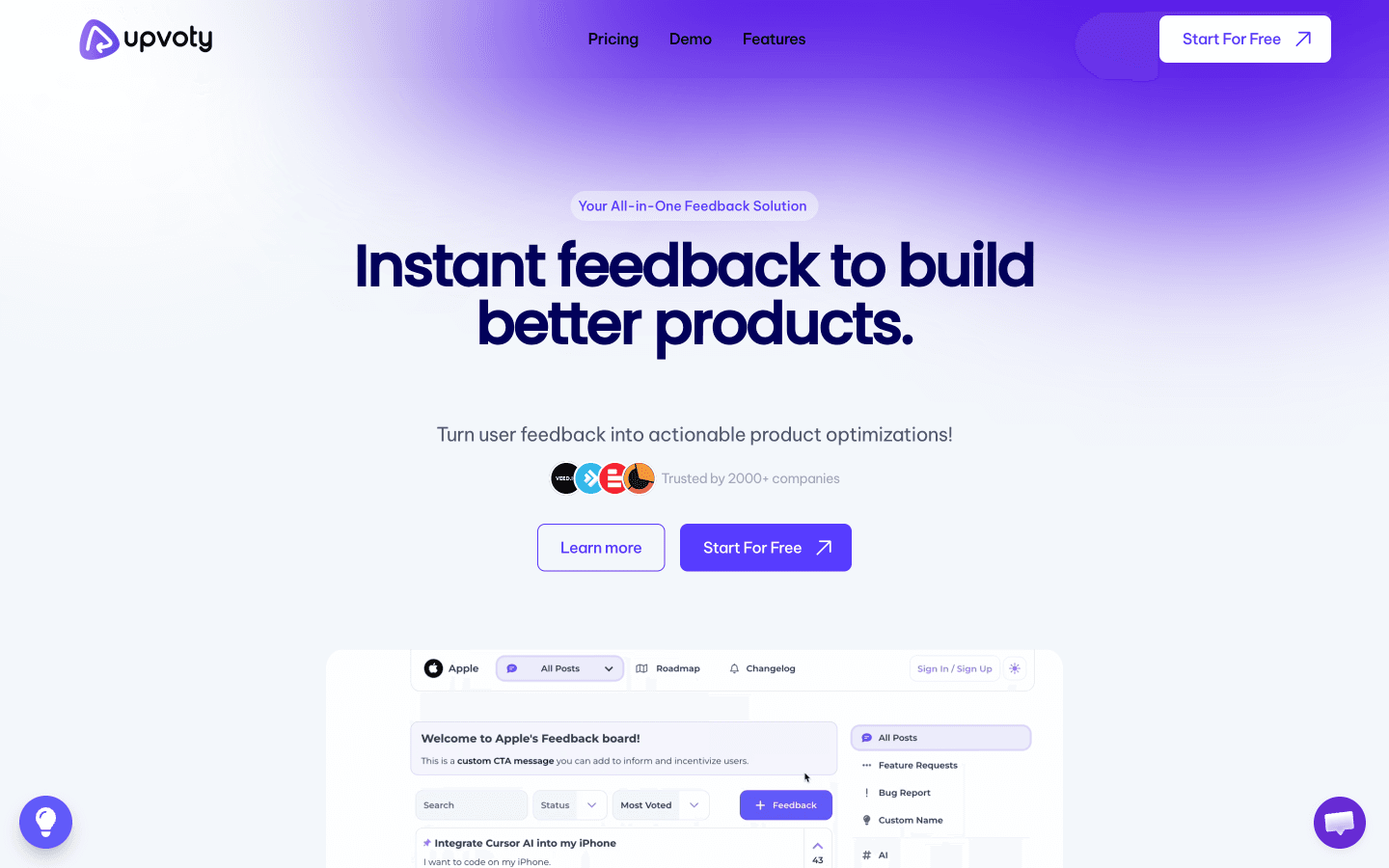
A straightforward feedback board with voting, roadmap, and changelog at a low price.
Best for
Budget-conscious startups that want a functional voting board without bells and whistles.
Pros
- Unlimited users, boards, and feedback on every paid plan
- Custom domain and custom HTML/CSS included at the entry tier
- Clean embeddable widgets
Cons
- No free plan — 14-day trial only
- No GitHub, Jira or Asana integrations
- No AI features
- Basic roadmap compared to competitors
Pricing: Power $25/mo. Super $49/mo. Hyper $99/mo. 14-day trial, no free plan.
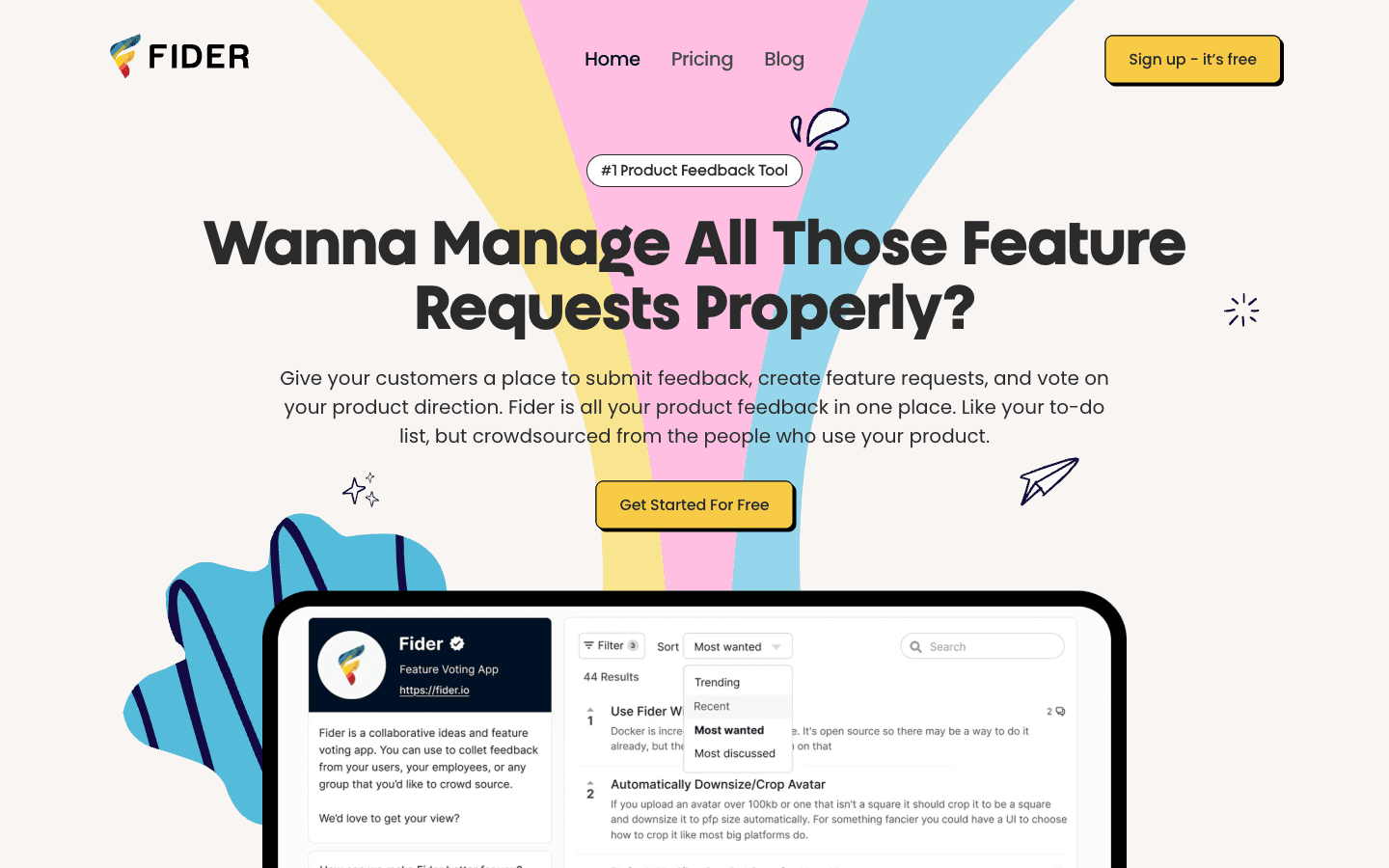
An open-source feedback tool you can self-host for free.
Best for
Engineering-led teams that want full data ownership and don't mind running their own infrastructure.
Pros
- Fully open source — MIT licensed
- Self-host for free on your own infrastructure
- No user or idea limits
- Active community and maintainable codebase
Cons
- Requires engineering effort to deploy and maintain
- UI is more utilitarian than polished
- Limited integrations out of the box
- No AI features
Pricing: Free and open source (self-hosted). Paid hosted plans available.
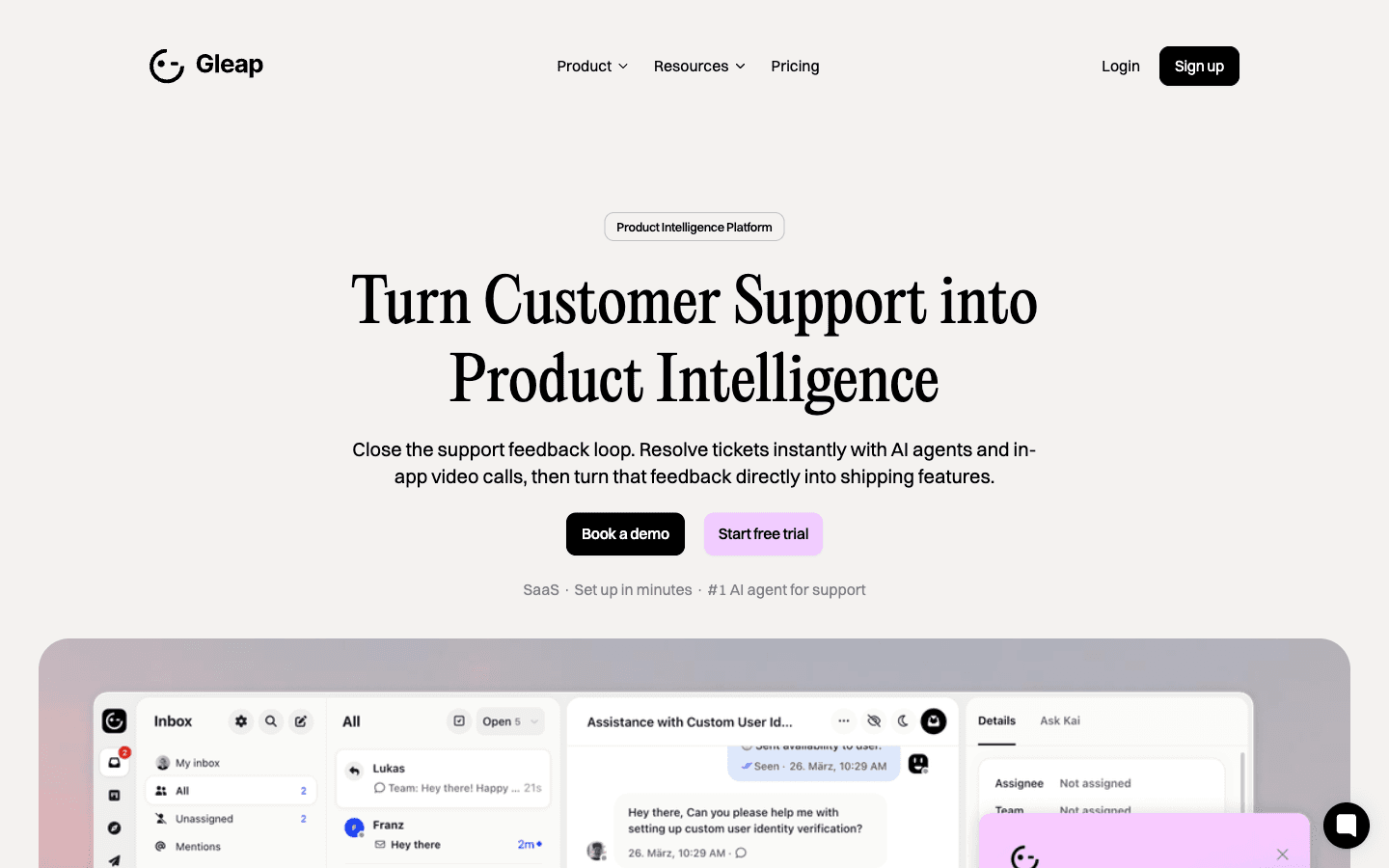
Bug reporting, live chat, and feedback in one customer support OS.
Best for
Teams that want visual bug reports and live chat alongside feedback collection.
Pros
- In-app bug reporting with screen recording and annotation
- Live chat and AI chatbot (Kai) bundled in
- Multi-channel support (widget, email, WhatsApp)
Cons
- No free tier — minimum $39/mo
- Heavy product footprint if you just want a feedback board
- Additional costs for AI responses and emails
Pricing: Hobby $39/mo. Team $149/mo. Enterprise from $999/mo.
The enterprise feedback platform that pioneered the category in 2008.
Best for
Large enterprises with complex feedback workflows, Salesforce integrations, and dedicated CS teams.
Pros
- Mature platform with enterprise-grade features
- Deep Salesforce and Zendesk integrations
- Trusted by Adobe, GoDaddy, Dropbox, Box
- Customer intelligence reporting
Cons
- Extremely expensive — $699/mo minimum
- No free tier or self-serve signup
- Long sales cycle just to get started
- Outdated interface compared to modern tools
Pricing: Starts around $699/mo. Sales-led — no self-serve signup.
Frequently asked questions
Why look for a Canny alternative?
Canny's Pro plan — the tier where PM integrations (GitHub, Jira, Linear) and remove-branding unlock — starts at $79/month. The free plan caps at 25 tracked users, and the Core plan ($19/mo) has a limited integration set. For teams that want those integrations on a flat plan, modern alternatives offer similar or better features at a lower total cost.
What is the cheapest Canny alternative?
Fider is the cheapest option because it's free and open source — you can self-host it on your own infrastructure. For managed options, Feentra, Featurebase and Sleekplan all have free plans. Among paid plans, Sleekplan's Starter tier at $13/mo (annual) is the lowest, followed by Frill and Upvoty at $25/mo.
Which Canny alternative has the best AI features?
Featurebase and Productboard lead on AI synthesis and support automation. Feentra focuses AI on the feedback loop itself — automatic duplicate detection and priority scoring on every plan, including the free tier.
Do any Canny alternatives offer flat pricing?
Yes. Feentra, Frill, Nolt, Sleekplan and Upvoty all use flat pricing rather than per-seat billing. This is a major advantage for small teams — a 5-person team on Canny or Productboard pays hundreds per month, while flat-priced tools keep costs predictable.
Can I migrate my existing Canny data?
Most alternatives support CSV import for ideas, voters and comments. Canny offers a data export in JSON format on all plans. Feentra, Featurebase and Sleekplan all provide import tools or migration assistance on paid plans.
Try Feentra free
The fastest way to collect feedback, prioritize with AI, and ship what users actually want. Free forever on the starter plan.